
Listen and Download
Please enjoy these excerpts from some of the music I have released. Since a lot of what I am writing doesn't really fit the typical 2-minute pop tune format, it is hard to get a feel for the composition from the short 30-second or 60-second previews allowed by most platforms, So I have included some longer previews here.
To hear the complete tracks any time you want, you can download them from my store right here.
Thanks for listening!
‘Solstice Concerto’
Solo piano version
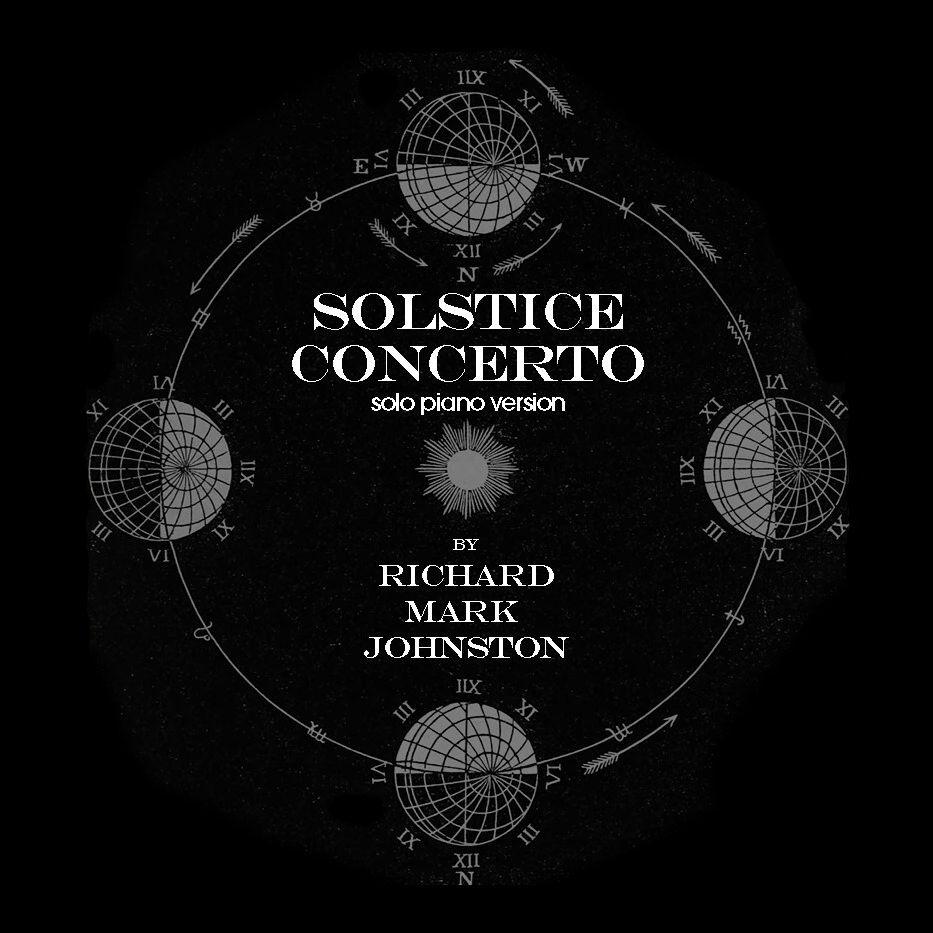
For thousands of years before the early Christians co-opted the observance of the winter solstice into Christmas, the pagans tracked the point on the horizon at which the sun rose and set. The winter solstice - the day on which the point of sunrise stopped moving southward along the horizon and began moving northward again (in the northern hemisphere) - was determined through repeated annual observation.
Elements in structures like Newgrange (constructed in Ireland around 3200 BCE), Stonehenge (England, between 3000-2000 BCE), and Maeshowe (Orkney, circa 2800 BCE) are aligned to the point where the sun rose on the winter solstice. This suggests a high degree of awareness by the human societies that built these monuments to the seasonal turning point represented by the winter solstice.
Thus the winter solstice appears to be among the earliest cosmological phenomena observed by humans, predating written religious texts, formal theology, or mathematical astronomy.
In the Roman calendar during the early days of Christianity, December 25th was celebrated as the date on which the days began to lengthen again. Christians were quick to appropriate this date as the day of Christ’s birth even though the New Testament gives no birthdate and the early Christians treated Easter (the purported date of Christ’s resurrection, celebrated in late March in the Roman calendar) as a much more important event. However, It was expedient to re-interpret, compete with, or absorb the existing popular pagan winter festivals into what became Christmas. By the mid-fourth century, December 25th was firmly established as Christmas in Rome.
But with advent of more sophisticated observational and mathematical astronomy, we now know the date of the winter solstice with much better accuracy and precision and it is placed on 21 December on the Gregorian calendar in use in the Western world.
Here in north central Colorado it is the dark, not the cold, that affects me the most. Having dinner several hours after sundown, thinking it is almost time for bed, and looking at the clock to realize it is only 7:30 pm is tough. In December, the sun appears at the southern shoulder of the mountain to my east, slides along the horizon behind the tall Ponderosa Pines, and then disappears again behind another peak to the south.
So I pay close attention to its changing trajectory as it appears a little earlier and a little higher each morning in my east-facing window. Until finally in the Spring it never hides behind that eastern mount at all - it climbs above the valley way to the north, clears the hills and the pines, and finally descends behind the ridge to the west.
So here is a composition celebrating the turning point that is the winter solstice. We still have months to go before the hummingbirds return, the wildflowers bloom, and the days are long - but the trend has begun.
‘Uh-Oh’
If ever there was an exclamation apt for the year 2020, maybe ‘uh-oh’ is a candidate.

Because the human race continues to fuck things up at what is literally a blistering pace. Climate protection, fair access to and use of resources, access to health care, freedom to fairly evaluate and choose political leadership, gender and race equity, and the ability of people to discern and value truth in the face of a well-developed and well-financed infrastructure of bullshit - all of these indicators of a healthy society appeared to continue to deteriorate in 2020.
Nevertheless, this piece of music isn’t really ABOUT that trajectory, but DESPITE it. It wasn’t written in contemplation of those negative indicators, but in negation of them. And honestly, it’s titled ‘Uh-Oh’ because the cadence of the first two chords of the piano and the first two notes of the saxophone just reminded me of ‘Uh-Oh’.
Anyway, if it manages to make you snap your fingers or tap your foot for a few moments, I’d consider that a good result.
‘Uh-Oh’ Audio Previews

ABOUT "ON A RISING WIND"
This piece starts out dark, with a sombre cello solo. The dark mood doesn't last long, as we start to hear a rhythmic cycle of strings - perhaps the beating of wings? Soon enough, we start to soar on a flowing horn section which momentarily diverts our focus from the beating of our wings and draws our attention to the panoramic view unfolding before us. A feeling of peace arises. We become a bit introspective. But we are still flying, and we soon realize the power and grace of our flight. No matter what has happened to us up to this point, everything will be alright.
“ON A RISING WIND”
AUDIO PREVIEWS
About "Winter Solstice Procession"
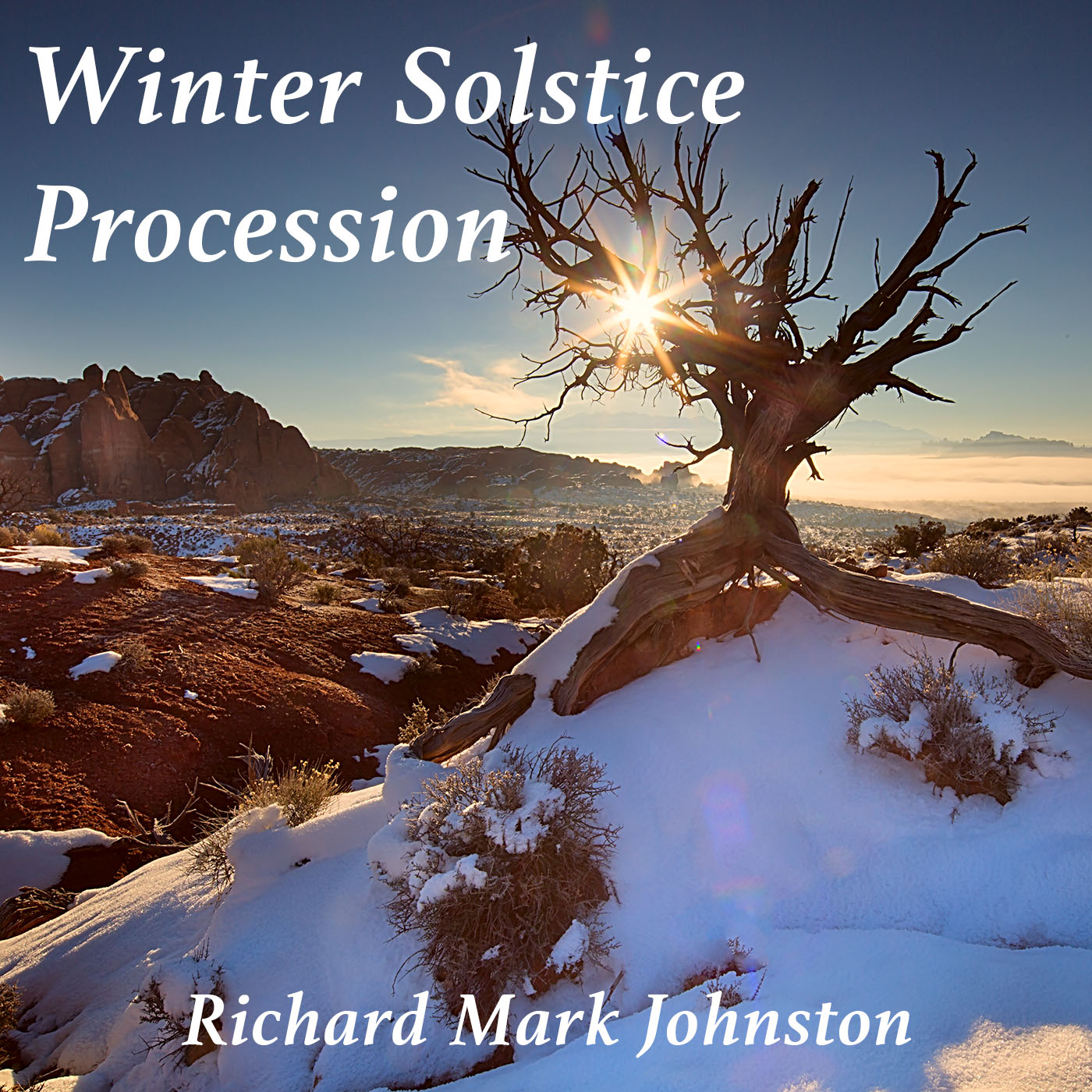
This track is a stately orchestral track celebrating the "return of the Sun" - the days starting to get longer at the Winter Solstice - and looking forward to Spring. It features big string and horn sections, and especially the trumpet.
I imagine this music being played as celebrants gather to mark the passage of Winter and acknowledge the bounty of the Earth as the seasons turn towards Spring.
“Winter Solstice Procession”
Audio Previews

About "Boulder Field"
"Boulder Field" is a bit jazzy, with a finger-picked guitar intro - joined by the oboe [one of my favorite orchestral instruments]. It hops around from a confidant sort of stride, into some more spacey, ethereal sections, and then has a very jazzy break with organ and bass guitar.
“Boulder Field”
Audio Previews
ABOUT "BERGLANDSCHAFT"
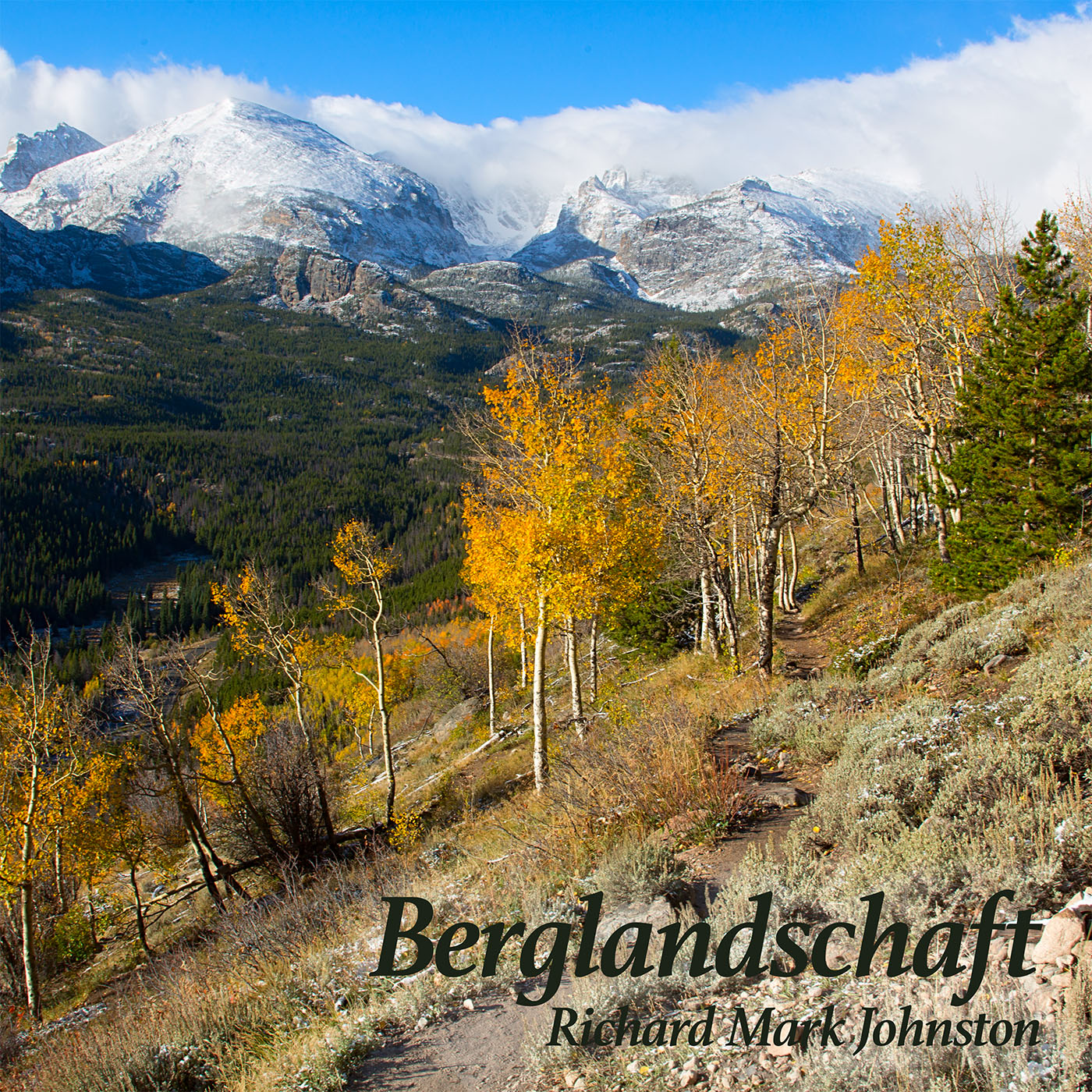
"Berglandschaft" means "mountain scenery" in German. This one starts out with a chorale - first male voices, then female - followed by themes carried by bassoon, oboe, other horns, and strings. It's a gentle piece - almost conversational. I always feel like the mountains talk to me in some way when I walk among them - I hope this music speaks to you.
“BERGLANDSCHAFT”
AUDIO PREVIEWS

About "Sky Poem"
"Sky Poem" is a paen to the magnificent skies above the Front Range of Colorado's Rocky Mountains. It features big horns and strings, big percussion, and a majestic, sweeping musical theme.
Video and "Sky Poem" Sound Track

Here's a video of some dramatic skies over the town of Lyons, Colorado, with "Sky Poem" as the sound track.

The Music
The piece starts in a contemplative mood and ends up that way, too. Various things happen in the middle - listen to the audio previews below to hear some of them!
“SUSQUEHANNA”
I didn't start out writing this about a river, but as it took shape, it reminded me of how a river flows and grows. Starting out as a seep or trickle somewhere in the hills, gathering speed and strength as it moves downhill, sometimes meandering lazily through broad flat plains, and eventually being dissipated into a larger body of water.
The Susquehanna River is the largest North American river that flows into the Atlantic Ocean. It starts in the rural reaches of New York and Pennsylvania, runs down through the Allegheny Plateau, and empties into the head of the Chesapeake Bay. It drains an area the size of Ireland - over 27,000 square miles.
The west branch of the Susquehanna River flows northeastward from western Pennsylvania, and joins the north branch flowing south out of New York before it empties into the Chesapeake Bay.
The Susquehanna is one of the world's oldest rivers, and predates the mountains through which it currently flows.
“Susquehanna”
audio previews

About "Amagisan Doro"
"Amagisan" is the name of the highest peak on Japan's Izu Penninsula, which lies between the Pacific Ocean and Suruga Bay just south of Mt. Fuji. "San", written 山 and also pronounced "yama", means "mountain". And the name Amagi is written with two characters, 天城, which mean "sky" or "heaven" and "castle".
"Amagisan Doro" means "Amagi Mountain Road" and was written to commemorate the many happy hours I spent hiking in the mountains in the Amagi region during my residence in Japan. It is peaceful and a bit wistful, and features sounds evocative of the shakuhachi, Japan's traditional wooden pipe, and the koto, a wooden harp-like instrument whose strings are plucked.
“Amagisan Doro”
Audio Previews
Video and "Amagisan Doro" Sound Track
Here's the music of "Amagisan Doro" accompanied by a sequence of photos I took during my hikes in the area after which the compostion is named.

About "Rain on the Tarn"
A tarn is a small body of water that lies within a bowl scooped by glacial activity in the high mountains and filled with melted snow and rainwater.
"Rain on the Tarn" is about sitting in front of a pool of placid water and watching raindrops fall onto the surface from storm clouds that swirl around the peaks high above, inspired by walks in the Rocky Mountains of Colorado.
It's a peaceful tune that features a sort of celtic harp and pan flute with cello and other strings.
“Rain on the Tarn”
Audio Previews

About "Traoghadh Doineann"
Don't worry, I can't pronounce it either! Let's call it "Subsiding Storm".
The tune begins with a somewhat menacing, driving violin line that finds its way into other instruments as the song progresses. It weaves and dances its way into some big horns with a jumpy piano accompaniment until it subsides into a flowing, majestic theme, just as a stormy and wind-whipped sea eases into big swells, and finally, calm.
“Traoghadh Doineann” Audio Previews

ABOUT "FLYING CLOUD"
This is a rollicking bluegrass tune featuring resophonic guitar [often referred to as "dobro" after one of the earliest brands of the type], plus mandolin, pipes, bass, and piano.
It's a brisk waltz whose rhythm reminds me of the motion of a sailing vessel.
It is named after the clipper ship that held the speed record for sailing between New York and San Francisco - 89 days 8 hours - a record that stood from 1854 to 1989!